Photo: Hero Images/Getty Images
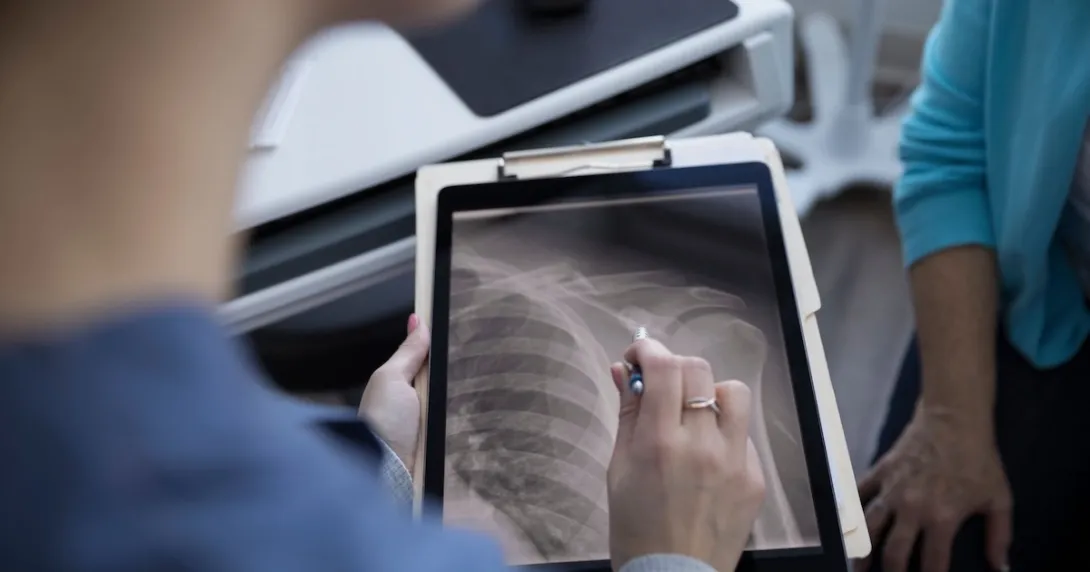
Seoul National University Hospital researchers have come up with an AI model that can both classify and explain bone densities in chest X-ray images.
WHAT'S IT ABOUT
The research team collected data from approximately 14,502 women who underwent chest X-ray (CXR) and bone density test (DXA) examinations at SNUH Health Promotion Center between 2004 and 2019.
These were analysed using four different AI foundation models – two trained on general images and two trained on medical images. In each model, three validation approaches were applied: linear validation, partial fine-tuning, and low-rank adaptation, to assess predictive performance.
Each model identifies whether a CXR shows normal bone density, osteopenia, or osteoporosis by assessing relevant features, such as the spine and ribs, and then comparing them with its learned patterns.
An explainability system was also developed to confirm the highlighted area in the CXRs that forms the basis of the AI's judgment. It quantitatively verifies whether the AI makes judgments based on clinically significant bone structures.
Findings published in Osteoporosis International noted that one of the models trained on general images (DINOv2) and validated through low-rank adaptation showed the highest predictive performance among models, with an area under the curve of 93%.
WHY IT MATTERS
The study's findings suggested AI's potential for opportunistic screening to detect osteoporosis – characterised by low bone mass and weakened bone structure – early without the need for a separate bone density test.
Key to this, the research team noted, is verifying its basis of judgment. The research team specifically sought to address black box problems in existing AI models through their research
"When applying a foundation model to medical images, high performance alone is not enough. A multidimensional evaluation system needs to be trusted in actual medical settings," said study first author Kim Jae-won, a researcher at the SNU Department of Medicine.
"This study is significant in that it presents the criteria for such a system," he claimed.
It also "provides guidance on how to select and utilise foundation models," added SNUH professor Park Sang-min, who led the study.
MARKET SNAPSHOT
A local medical AI company, Promedius, obtained regulatory approval from the Ministry of Food and Drug Safety for its osteoporosis diagnosis support AI software. Its solution also helps identify osteoporosis from a chest X-ray.
Taiwan-based Acer Medical also received similar approval from the Indonesian Ministry of Health last year for its AI-assisted software, which analyses bone mineral density and predicts T-scores in X-ray images.
The National University Health System in Singapore has also developed an AI that flags in real-time cases of hypercalcemia, which can lead to osteoporosis.