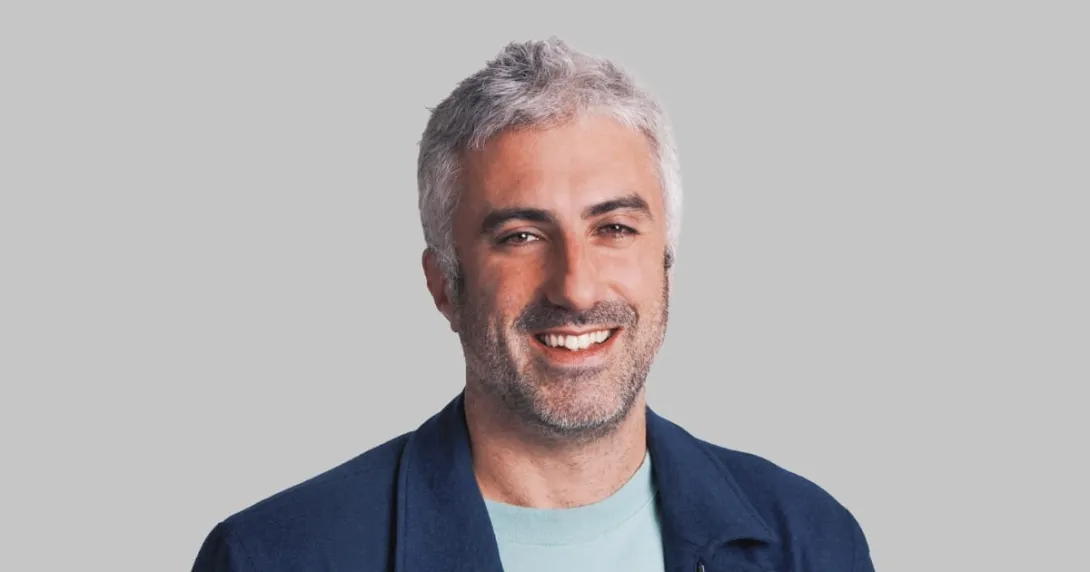
Thomas Clozel, cofounder and CEO of Owkin
Photo courtesy of Owkin
SAN FRANCISCO – Outside the JPM Healthcare Conference held here this week, Thomas Clozel, cofounder and CEO of Owkin, sat down with MobiHealthNews for an in-person interview to discuss the company’s biology-focused AI platform and his broader critique of the pharmaceutical industry’s short-term focus on pipeline wins.
MobiHealthNews: Can you tell me about Owkin?
Thomas Clozel: Owkin is a company I founded about 10 years ago to be able to really understand biology. I was an oncologist at the time, and I felt very frustrated that I had patients who were sometimes very young, but had cancer and no idea why they were relapsing, and, just, we had really no idea.
Biology, in general, is so complicated that it's not accessible to the human mind. It's too complicated. There's too many scales, too many modalities and everything. You just felt that you had to use a different type of intelligence.
So, Owkin was built to build a new intelligence to try to capture biology, and especially one side of biology, which is the causality of biology – the cause of diseases.
Today, everything we discover is really correlation, but it's not the cause of why people have cancer, and for me, that was really the first step before ever building better drugs and everything.
So, today, what we're trying to build is using this intelligence, especially based on biology, but also on drug development and discovery, to really build an AI scientist, which is an AI scientist as an agent that has a lot of skills, reasoning skills like LLM, analyzing images, discovering new molecules, everything, that can really replace the future of pharma R&D. Today, future teams of R&D in big pharma are like hundreds of thousands of people. We want to replace it with, like, one. Why not? That's been the project.
MHN: So, what are you currently working on?
Clozel: We are finalizing this one platform. The platform has to be data from patients. So you have to have fuel for these AI scientists. The first is data. So, we are trying to partner with the largest hospitals in the world. We have 80 of the 100 largest, where we put our own infrastructure, and we try to really curate a lot of very deep patient data. That's really what we've tried to build. This is really the fuel of the engine.
And then we are really working a lot on the reasoning skills of the agents, which is a new LLM that we hope will be better than Claude and GPT-5, and we are really trying to make it reason and especially find new things and understand causality, as I said. So we work a lot on this one. We just announced a partnership with NVIDIA this morning. They're going to help us.
And yesterday, with Anthropic to collaborate on different things. But NVIDIA is on the reasoning skills, the reasoning model. And then we are integrating everything into one platform, and this platform can serve hospitals in being able to integrate data and build new intelligence for biology, helping people automatize research, but also pharma to replace this R&D with new research.
And it really goes the full stack, from finding a new biology to building a molecule, doing better clinical trials. Everything is skills from the agent; he can do everything.
MHN: What are you training your models on?
Clozel: We are really training the models on – the idea is to find ground truth in human biology. So, it really has to be patient data, but patient data has to also capture the immune system.
We really focus on gathering a lot of patient data with special biology that can really capture the immune system and understanding that. So, that is the data we use, and that's the first type of data. So, we have more than 1.2 million patients that have a unique single cell level worldwide. That's from the 80 best hospitals.
Then we also use agentic data, so people using the platform giving us feedback, and a lot of professors of medicine use it and give us feedback on that.
And the third one is we actually also try to capture context. You know, biology is really context-dependent. You can do an experiment, you change one degree in the room, it changes completely.
And the three types of data – agentic, patient-derived and patient data – feeds the AI scientist to be better every day. For the new LLM we built, for example, our reasoning model, using this special data, very deep data, the performances were even starting to get better than OpenAI and Claude and Anthropic performances, because you really capture a lot of information having this type of very deep data access.
MHN: So, agentic AI is not overlooked by humans. It is developed and it learns from itself.
Clozel: Yeah.
MHN: And it's not necessarily ...
Clozel: Copiloted.
MHN: Yes. So, how do you make sure there are no hallucinations?
Clozel: That's a really good point. First, we have two versions of our AI scientists. So, Dr. Mowki is himself, so he's auto-piloted.
First, we try to have a ground truth of everything we do, because, you know, in biology, everything you discover in AI for biology is bullshit by design, unless you prove it wrong, and you need to validate in the lab, but also with patients in the real world.
So, we also have what we call a patient validation hub, which gives us the reality check of what we do, which is building our own molecules and our own diagnostic tools, patient identification tools, where we can identify responders to treatments. And this is just a fact to show that what we discover is true. So, we have a lab in the loop that runs all the time, 24/7, but we also have these kinds of patient clinical programs.
MHN: How soon do you think you will have outcomes?
Clozel: We have readouts of our first treatment in a few months only. We already have two diagnostic tools that are approved that are first-in-class. We are able to predict relapse of triple negative breast cancer for the first time in the world, and it's built by the platform.
MHN: How accurate is it?
Clozel: It is very accurate. It's the same accuracy that another test called Oncotype DX, but it's one click, and we have the same performance, and it takes one second. And we are able to predict BRCA mutation.
So, we do a lot of things. We have new treatments coming in. We are building a lot of things. So, that's kind of the clinical readouts. But we also have performance readouts where we will publish very soon the new results from our models that outperform the competition. There's a little bit of a first-in-the-class kind of competition in these things.
But I'm a doctor. It's a bit different the way we see things. I mean my competitors, they are not doctors. It's different. I really understand what treating a patient is in the end.
MHN: What do you think you'll ultimately be able to accomplish? Do you think you'll be able to cure any diseases?
Clozel: Yeah, we really think we're going to go to causal biology. I think, like three, four years. We really want to work on the cause of Alzheimer's, really trying to understand the cause of relapse, why people relapse, and try to target that. That's kind of what we want. And we want this platform to also accelerate research. What we want is this platform to be adopted at scale, multiple hospitals and everywhere. And we just want it to be the reference platform.
MHN: So, what's next?
Clozel: I hope, I mean, the only proof points is to treat some things that were not treated, and to be able to do it, and replacing some teams. Trying to show that there's no need to be 100,000 people at Pfizer to discover zero drug. You can quote me. It's like, literally, it's incredible. The ROI, wow, it's very small.
But if you don't have the right biology from the start, which is the most difficult thing I think, everything's wrong. And we miss this. And a lot of people are focusing on chemistry. I think the biggest paradox is in pharma. I think the future of healthcare companies that are going to discover the best drugs will be AI companies. I bet on OpenAI, Anthropic, Owkin, really, in five, six years. I think that pharma has so much legacy, it's going to be a bit tougher.
And my last point, I think that makes the revolution a bit difficult, is there is a structural problem for pharma in timelines, to build this, because, first, big CEOs of pharma are making too much money, and so their only goal is to make another year of making too much money.
So, they seem very like short-term [focused], and they want to create very direct pipeline value. So when they bring AI, they want a very direct change on the pipeline, which goes against building real strong foundation on data layers, infrastructure. It's a bit of a problem.