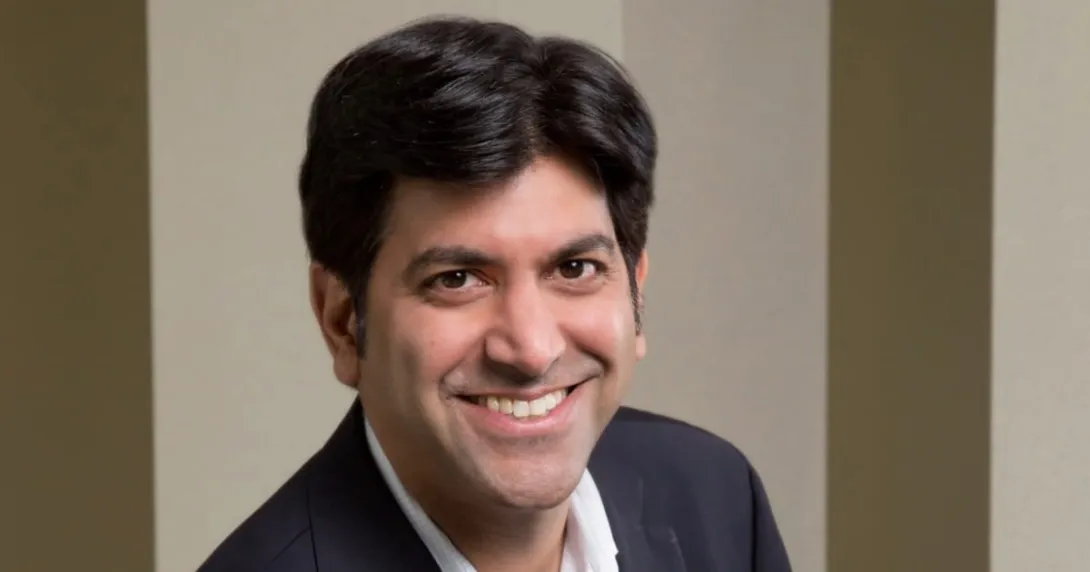
Aneesh Chopra, first chief technology officer of the U.S. and current chair of the Arcadia Institute
Photo courtesy of Arcadia
LOS ANGELES – Aneesh Chopra, who served as the first chief technology officer of the United States appointed by President Barack Obama and currently the chair of the Arcadia Institute, sat down with MobiHealthNews for an in-person interview to discuss AI's place in healthcare and the promise of the technology in finding therapeutics for diseases.
MobiHealthNews: You served as the first chief technology officer of the United States. You obviously are very knowledgeable when it comes to technology. Do you think that we are in an AI bubble?
Aneesh Chopra: No, I am actually quite bullish on where we are. I'm not a financial speculator, so I can't speak to the individual valuations, but broadly speaking, vast parts of our society stand to benefit from the incorporation of AI in making the systems and processes better.
I'm particularly motivated for it in healthcare. We have been promised a productivity revolution on account of digitization, but if you look at the statistics, healthcare productivity, I think, is the only industry vertical where we plowed in billions of dollars of digitization and productivity has gone down. We require more staff time, more labor hours per task than you would have asked or expected if this were to be a true Alan Greenspan-style productivity revolution, as he noted in the '90s.
AI may be seen as the last mile to unlock the productivity promises that we were waiting for in the digitization chapter. So, I think of it more as a continuation of our old thesis, but with better capabilities, as opposed to a new wave, and either way, when you have so much potential to make our systems more effective and efficient, you are only looking at the very basic levels of economic performance today powered by this. I'm bullish, and my entire life today is dedicated to thoughtfully, responsibly incorporating AI tools into the care delivery system.
MHN: So we're not necessarily in an AI bubble, but do you think there is a lot of hype around AI?
Chopra: Of course! First of all, let's state the obvious. There's nothing in the world where you just pour technology and it magically solves. Let me flip the narrative from bubble to hype. I'm anti just add tech to solve things. But thankfully, the capabilities in this new age, on top of the interoperability moment we're about to jump into, on top of some of the economic incentives around how we pay for care, you put all three together, and you've got rocket fuel, as we used to say in the Obama administration, for an innovation ecosystem.
Now, what does that mean practically? If you got a fee-for-service system, and you're trying to maximize the economics of any one component (let's say provider billing), AI has been deployed, but as Elevance said in its earnings call, I think six months ago, the net effect of it has been "upcoding" in the delivery system.
Then you flip it, and you say to the health plans, "Okay, so what is your version of that?" Well, we're going to automatically downcode unless you prove the clinical efficacy of your intervention. So, payment integrity goes up on the one side, upcoding on the other, and that feels like an inflationary arms race – quite the opposite of a productivity revolution. It's a deadweight loss, basically.
So, you need an economic system, in my view value-based care, that rewards the clinical use cases that actually improve people's lives and not just push paper around. And that, you can't just add water. You need policy change. You need that process and workflow. You need to have clinicians who embrace that vision, health plans willing to seed some of those functions. That's a process change. That takes time.
MHN: That's where that need for private-public collaboration comes in.
Chopra: It is. And the way to think about that is, as Medicare goes, so does the rest of the health economy, in many ways. When you get to the size and scale of Medicare, it is a market maker.
And so, as you saw in the Trump administration, the ACCESS model is the purest form of pay for outcomes. They've eliminated CPT billing codes. You can't upcode. There's one code. The code literally is, did you treat the patient and you get paid half, and did you deliver the outcome? You get paid the other half. You can't get more basic performance-based payments than that. And after CMS announced this a few months ago in December, we now see, I don't know, 100 million Americans have health plans that voluntarily pledged to join in on the CMS approach. That's fascinating.
MHN: Some people say, though, that the cost the ACCESS program is willing to pay is not very much.
Chopra: That's actually a feature, not a bug. Today, we have this fee-for-service fueled, additive, inflationary denominator. So, what more can I do to add billing codes? There's a code that you can add for complexity that adds $16 a visit. You can add a code for, you know, remote monitoring and all these things that have very little impact on the patient population, because they've not been deployed at scale. They've been largely maximized, if you will, by organizations that really understand fee-for-service billing.
The shift with ACCESS is it's actually shifting it away from building on top of a broken system. So, we can have a completely parallel system, and you're either in it or you're out. You can't be a foot in two canoes, as we say in the ACO community. You got to be all in on ACCESS (payments for outcomes) or you're in fee-for-service. You can't be both, and it's going to be fascinating, like the Harry Potter sorting hat, which care delivery organizations step into ACCESS because they have to give up, effectively, fee-for-service billing altogether.
MHN: Going into what the Trump administration is doing right now. Last year, President Trump announced Project Stargate, where they are building giant AI ...
Chopra: I think he celebrated the announcement of Stargate. I don't know if he announced it as a government action. It was a private sector ... it was celebrating it.
We did this a lot in the Obama administration. You want to call, celebrate, inspire, motivate. And so I think, if I'm understanding the math correctly, I'm not in the weeds, but a bunch of companies, including Masayoshi Son, Oracle, they committed the capital with OpenAI to build a next-generation data center. And I think the president celebrated that mostly to highlight that he wants to win the AI race, and this is an example of winning by looking at capital into the market. But that's separate, okay, from announcing a policy.
[Editor's Note: Project Stargate is a public-private initiative championed by the Trump administration to build an advanced AI infrastructure in the U.S. While the president announced the initiative at the White House, it is not a government-funded project. Rather, it is a $500 billion private-sector endeavor, with initial funding and leadership from OpenAI, SoftBank and Oracle.]
MHN: That project is a huge initiative, right? A lot of what Larry Ellison said during the announcement was that the group would be able to find treatments for cancer and many other promises were made.
Chopra: I share that view. I think we're going to find ... think about the wide-ranging opportunities to test a hypothesis, which would take an individual researcher applying for an NIH grant, waiting for the funding, organizing the teams, deploying it, you're measuring that in months, years realistically. Now imagine if you sort of download this capability and have its AI agents essentially run the hypotheses and multiple, you might have 10 in your head, and they can actually execute that in a much more cost-effective way. So, it amplifies.
So, if I'm a researcher, and I have a few shots on goal with my RO1 grant [Research Project grant] from NIH, but now you give me 100 AI agents, 1,000 AI agents who do my, effectively my bidding, and I guide them into a better way, how much more productive will the scientific enterprise be to discover ways that some novel biomarker could trigger something that allows us to find a new therapeutic to slow disease progression? I mean, I'm just ecstatic at the possibilities.