Photo courtesy of Qure.ai
Qure.ai receives Gates grant for lung AI
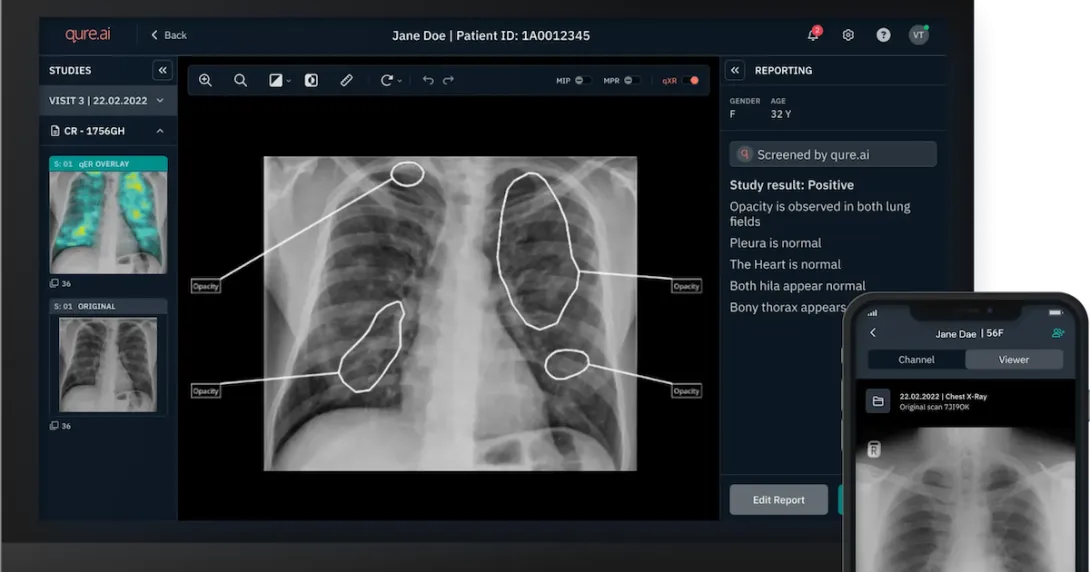
Qure.ai has received an undisclosed grant from the Bill & Melinda Gates Foundation to develop open-source datasets and AI tools for lung disease detection in under-resourced health settings.
The reported multimillion-dollar funding will support the creation of a large multimodal database aligned with World Health Organization lung health diagnostic pathways, combining non-identifiable clinical histories, medical imaging, cough recordings, and laboratory markers. It will also be used to develop AI-enabled point-of-care ultrasound algorithms for early tuberculosis (TB) and pneumonia detection.
According to Qure.ai, these projects build on its existing global deployments of AI-based imaging tools for TB, lung cancer, and stroke across more than 105 countries and 4,800 sites worldwide.
Digital women's clinic Pinky Promise bags $1m pre-seed
India-based health startup Pinky Promise has raised $1 million in a pre-seed funding round led by the Rebalance Angel Community to scale its AI-driven digital clinic for women.
Its mobile application-based platform combines proprietary AI systems with gynaecologist oversight to deliver 24/7 virtual consultations, prescriptions, and care guidance for sexual and reproductive health conditions.
According to the startup, its fresh funding will support the rollout of physical clinics, expansion of integrated digital care offerings and supplements, and further scaling of its services, which already reached more than 350,000 women across India.
Hong Kong to enable radiology uploads from mainland
Hong Kong's Health Bureau will allow residents to authorise designated medical institutions outside the city to upload radiology reports and images directly into their personal eHealth accounts.
The new "Personal Folder" function in the eHealth mobile app will enable radiology data (including high-resolution images) from three mainland providers – namely, the University of Hong Kong-Shenzhen Hospital, Shenzhen New Frontier United Family Hospital, and Zhongshan Chen Xinghai Hospital of Integrated Traditional Chinese and Western Medicine – to be securely uploaded using QR-code authorisation.
Launching on 27 January, this update extends Hong Kong's eHealth system to support cross-border care continuity, allowing residents and caregivers to share overseas radiology records with local providers for follow-up treatment.
HD partners with Pacific Prime on AI care access
Bangkok, Thailand-based digital health platform HD has formed a strategic partnership with Malaysia-headquartered regional insurance broker Pacific Prime to expand AI-assisted healthcare access for individuals and employers across Southeast Asia.
Under this partnership, Pacific Prime's individual and corporate clients will gain access to HD's HDmall and HDcare platforms, which connect users to healthcare providers, procedures, and surgical options in Thailand and Indonesia, supported by AI-based navigation to compare direct-pay and insured care pathways.
The collaboration comes as healthcare systems in the region shift towards hybrid financing models combining insurance coverage with out-of-pocket and self-funded care.