Photo courtesy of Nanyang Technological University
Algorithm-driven wearable robots have helped seniors stay active while preventing falls and requiring less assistance from physiotherapists in recent trials at active ageing centres in Singapore.
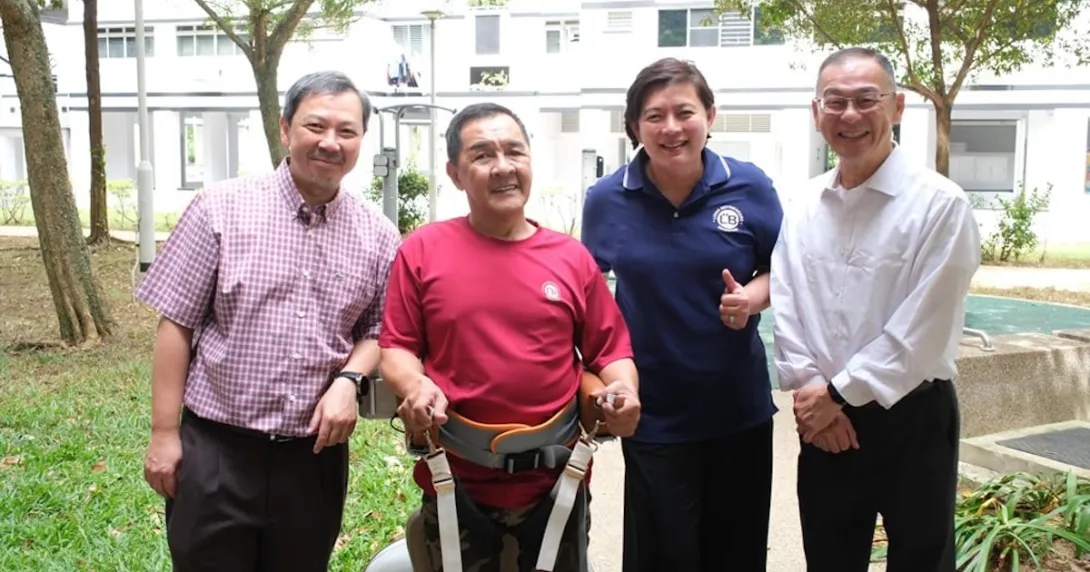
Powered by advanced algorithms and robotics, the Data-driven Robotic Balance Assistant (DRBA) assists wearers with daily activities such as standing, walking, and sitting. It is capable of providing immediate stability support when it detects a potential fall, and it can also tailor users' rehabilitation programmes by collecting and analysing data.
It was built on the first Mobile Robotic Balance Assistant, developed and introduced in 2022, minus the ability to transform into an electric wheelchair.
The DRBA was tried out at two AACs operated by Lions Befrienders in Tampines, involving 12 seniors in August. Sessions also included Zumba and other group exercise classes.
WHY IT MATTERS
The community-based trials found that users undergoing mobility rehabilitation with the use of DRBA required less assistance from their physiotherapists.
"DRBA was able to reduce manpower needs by at least 50%, [only] to ensure the safety of users during mobility exercises," NTU associate professor Ang Wei Tech, who supervised its development, explained to Mobihealth News.
"In the current practice, one caregiver or therapist is needed per patient; with DRBA, a therapist can supervise two or more patients at the same time. A DRBA operator only needs to go through a training session of about an hour," he added.
The three-week trials, however, uncovered one key limitation, which was logistics. According to A/Prof Ang, delivering DRBA on demand is "a challenge in terms of the availability and affordability of suitable transportation."
Ability Robotics, an NTU spin-off company he co-founded, is exploring several deployment models, including direct sales, long-term rentals, and on-demand hourly rentals.
"DRBA is designed to be a rehabilitation robot operated by professionals in institutional settings, while MRBA is designed as an assistive robot for consumers in community and homes," A/Prof Ang clarified. MRBA, which is lighter and comes with a wheelchair function, is set for sale to consumers this year, according to NTU.
The startup is also seeking to partner with community centres and healthcare organisations to deploy the DRBA for institutional use, with plans to scale across Singapore and other rapidly ageing markets across Asia. "Operators of AACs, like [Lions Befrienders], may apply for funding from government agencies such as AIC [Agency for Integrated Care] for funding to acquire capital equipment," A/Prof Ang said.
DRBA and MRBA were developed in collaboration with Tan Tock Seng Hospital at the Rehabilitation Research Institute of Singapore, a joint research institute between NTU Singapore, Agency for Science, Technology and Research, and NHG Health.